Research
PDELab develops the mathematics and algorithms that power advanced simulation tools for solving real-world problems described by partial differential equations. A key priority in the lab is developing methods with mathematical guarantees (this is essential for developing simulation tools that are reliable and efficient). The group works on a range of approaches, from high-fidelity algorithms (e.g., high-order methods) and scientific machine learning to algorithms that can be deployed on future circuit-based quantum computers. Application areas are broad, with projects involving industry partners in aerospace and commercial simulation software, government labs (aerospace and quantum computing), and a variety of municipal partners (infrastructure, data-driven decision making, etc.).
Research pillar 01
High-Fidelity Numerical Methods
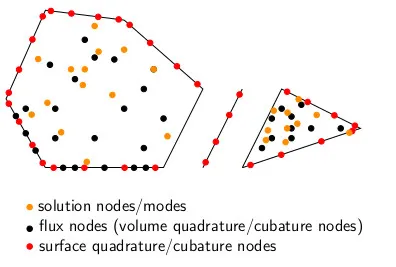
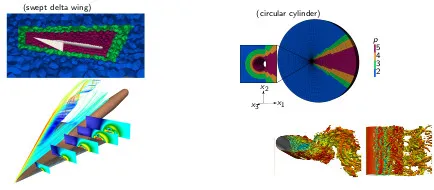
Modern high-performance computing (HPC) provides the computational power to solve increasingly complex real-world problems modelled by partial differential equations (PDEs). However, harnessing this power requires numerical methods that are accurate, mathematically reliable, and capable of exploiting rapidly evolving computing architectures. At PDELab, we develop numerical methods that combine mathematical rigour with computational efficiency. Our work on mimetic methods focuses on preserving fundamental properties of PDEs at the discrete level, allowing mathematical guarantees established for the continuous equations to carry over to their numerical approximations. We combine these mathematical foundations with high-order methods, which are particularly well suited to modern HPC architectures due to their high arithmetic intensity, adaptive methods that concentrate computational effort where it is needed, and algorithms optimized for HPC architectures, such as GPUs.
Focus areas
Summation-by-Parts Operators
Discrete operators that mimic integration by parts, providing a one-to-one correspondence between continuous stability and conservation proofs and discrete proofs.
Entropy-Stable Discretizations
Schemes that discretely preserve entropy inequalities, resulting in provably stable, and therefore robust discretizations for nonlinear PDEs.
Mesh Adaptation
Mesh adaptation (e.g., h/p/r) to enable efficient computation of multi-scale problems.
Moving Meshes
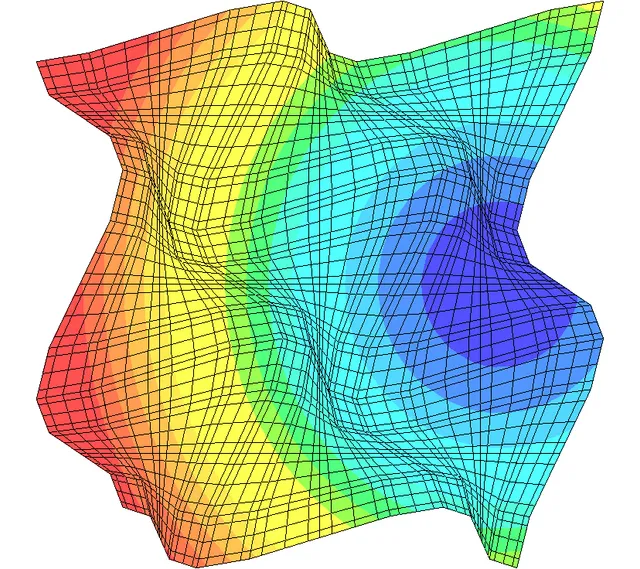
Provably stable and conservative discretizations for problems where moving meshes can be advantageous, e.g., fluid-structure interaction problems.
Residual Correction Schemes
Design-order corrections to the residual of a numerical method that enforce desirable properties such as stability and conservation on schemes that do not have these properties out of the box.
Space-Time Discretizations
Design provably stable and conservative fully-unstructured space-time approaches with application to mesh adaptation and feature tracking (e.g., shock-tracking).
Research pillar 02
Scientific Machine Learning
In the last ten to fifteen years, machine learning (ML) has seen meteoric success in applications such as image recognition and language processing and has ushered in a broad-based societal and work revolution. However, in applications where ML has seen extraordinary success, “good enough” is often sufficient, and for this reason ML has resulted in accelerating a multitude of workflows. However, in science and engineering, “good enough” may mean that key physics are incorrectly predicted or, worse, result in catastrophic failure of engineering systems. At PDELab, we are interested in two distinct ways that ML can accelerate simulation tools. First, we are interested in developing the mathematics, algorithms, and simulation tools powered by ML that are useful in science and engineering (i.e., ML algorithms that are sufficiently accurate and have mathematical guarantees). Second, we are interested in how ML can be used to accelerate key bottlenecks in simulation workflows (e.g., simplifying meshing and domain decomposition activities, accelerating nonlinear solvers, etc.).
Focus areas
Physics Informed Approaches
Learning parametrized approximate solutions to PDEs by weakly enforcing the physics and important properties (e.g., stability, conservation).
ML Accelerated Numerical Methods
Directly incorporating ML into high-fidelity numerical methods to improve their efficiency while retaining their mathematical guarantees.
Reinforcement Learning for Automatic Domain Decomposition
Using RL to develop automated domain decomposition pipelines to eliminate costly hand decompositions used in industry for high-quality meshes.
Research pillar 03
Quantum Computing
There exist fundamental limits on classical computing hardware and therefore on the opportunities to progress in both science and engineering. On the other hand, quantum computing has theoretically been demonstrated to provide exponential advantages for certain classes of problems in cryptography, chemistry, and physics. However, in the context of physics governed by PDEs, particularly nonlinear PDEs, it is still unclear if a quantum advantage will exist and under what circumstances it will exist. At PDELab, we are interested in understanding if quantum computing algorithms that retain the same favourable properties as their classical counterparts can be developed to solve both linear and nonlinear PDEs for real-world problems and under what conditions a quantum advantage can be obtained.
Focus areas
Block Encoding for Complex Geometry
Block encoding is essential for circuit-based quantum computing (it embeds a non-unitary matrix in a unitary matrix); developing efficient block encoding approaches for discretizations of complex geometry enables the application of quantum algorithms to real-world problems.
Carleman Linearization for Nonlinear PDEs
Carleman linearization embeds finite-dimensional nonlinear systems into infinite-dimensional systems; after truncation, the resulting ODEs are amenable to quantum computing algorithms.
Quantum Computing Optimized Numerical Methods
Methods that are efficient on classical computing hardware are not immediately efficient on quantum computers; key to developing efficient quantum algorithms is considering the full quantum computing pipeline from state preparation to readout.
Koopman-von Neumann for Uncertainty Quantification
Following spatial discretization, the KvN formalism recasts the resulting finite-dimensional nonlinear dynamical system as a linear Schrödinger-type evolution for a wavefunction defined over the system's state space. The squared magnitude of this wavefunction represents a probability density, making the KvN formalism a natural framework for uncertainty quantification.
Research pillar 04
High-Performance Computing
Developing numerical methods that are efficient on high-performance computing systems is essential to leveraging simulation tools to push the boundaries of science and engineering. At PDELab, we are interested in developing flexible numerical methods frameworks that are extendible and can be used to develop novel algorithms while retaining efficiency on HPC resources.
Focus areas
GPU
Current work at PDELab leverages NVIDIA's Warp ecosystem to obtain parallel advantage on modern GPUs.